When the Room Won't Stop Spinning: Shana Townsend on Dizziness, the Dizzy-Anxious Cycle, and Getting Your Life Back
Interview by Heather Anderson

Shana Townsend is a physical therapist with 32 years of clinical experience and a certified vestibular therapist and fall prevention specialist. She is the founder of Balance Solutions Rehab, a mobile practice serving the Bay Area, where she brings highly specialized vestibular care directly to patients' homes, offices, and wherever life happens to be. She is also the person your doctor will tell you to call.
You spent decades as a PT, seeing everything from open heart surgery patients to moms on bed rest. At what point did vestibular work go from "interesting" to "this is my thing"?
For most of my career, I was the ultimate generalist. ICU, ortho, stroke, maternity — I had to be ready for anything. And I loved connecting with patients, but I never felt like I had a specific area that I wanted to specialize in. When dizzy patients showed up at the hospital, we didn't know what to do with them. We'd give them a walker, hand them a number for a clinic in South San Jose, and send them home. I look back on that now and cringe. That was the best we had.
I took a balance course that had a small vestibular component — just a few video clips of abnormal eye movements. I couldn't follow it. They moved on too fast. But something about it got under my skin. So I ordered a DVD course, watched it on TV while working out on my elliptical, and I could finally pause and rewind. I watched those clips over and over until I could see the eye patterns. And I remember thinking — what is happening in your inner ear is being diagnosed by your eye movement. No MRI. No scope. Just your eyes telling the whole story. I was completely hooked and wanted to share my knowledge with the staff.
I ended up doing a few in-services at my hospital, but we just kept scratching the surface. Then I co-created an eight-hour continuing education course with an outpatient vestibular therapist who became my mentor, and we trained staff PTs and OTs across our system. I put hundreds of unpaid hours into that course. It was probably one of my proudest professional achievements. And it all came from seeing people get shuffled out the door with a walker when they actually needed real help.
“Fear makes everything worse. Understanding is genuinely therapeutic.”
For the mom reading this who just Googled "why does the room keep spinning" — what is a vestibular therapist, and what kinds of symptoms tell you someone's in your lane?
Your vestibular organ is your balance organ. It lives deep in your inner ear — past the eardrum, past the middle ear, tucked in where no scope can reach it. It is tiny. The whole thing could fit on a dime. And it does an astonishing number of things.
It tracks where your head is in space — whether you're tilting, turning, going forward or back. It stabilizes your gaze so that when you turn your head quickly, the world stays clear instead of blurring out. And it sends your brain the signals that keep you upright, so when you start to tip, your muscles know which ones to fire to catch you.
When something disrupts that system, the symptoms can be alarming. Classic vertigo is a spinning sensation — technically, it is an illusion of movement. It most commonly occurs with position changes getting in and out of bed, at the dentist or hair salon in people over 40, and is caused by something called Benign Paroxysmal Positional Vertigo (BPPV). But vestibular issues can also show up as floating, rocking, a sense that the floor is dropping, brain fog, ringing or pressure in the ears, nausea, headache, and light or sound sensitivity. These are common symptoms of vestibular migraine. A lot of my patients also have visual vertigo — that overwhelming feeling in busy places like grocery stores, airports, and Costco, where there's just too much visual movement for their system to process. Some people feel it when they scroll too fast on their phones, when sitting across from friends in a busy restaurant and need to turn their head side to side during conversations, or seeing things go by quickly while riding in a car. That vague sense of "there's too much going on for my eyeballs" is real, and it has a name.
I treat positional vertigo, vestibular migraine, inner ear infections, concussion-related dizziness, fall risk, and more. If dizziness or imbalance is affecting your quality of life, that is my lane.
A lot of people don't realize how emotional dizziness can get. What does the dizzy-anxious cycle look like in real life, and how do you help someone break it?
The cycle is exactly what it sounds like. You get dizzy. Your nervous system interprets that as danger. Anxiety spikes. And heightened anxiety actually makes the dizziness worse. So now you're more dizzy, more anxious, more dizzy — and around and around it goes.
I watch for this in every patient, and I weave nervous system regulation into almost every session. Because no amount of balance exercises will land if someone's body is stuck in fight or flight.
The autonomic nervous system has two branches. The sympathetic branch is your fight or flight system — heart rate up, pupils dilated, digestion shut off, blood rushing to your big muscles so you can run from whatever's coming. The parasympathetic branch is rest and digest — when things flow, when your body can actually repair and regulate itself. My goal is to give people tools to move toward that second state. And animals in the wild are actually much smarter than us about this: after a predator chase, they shake it off — literally — and go back to grazing. We just keep cycling about the thing.
I teach belly breathing, box breathing, and 4-7-8 breathing. I teach a grounding technique where patients feel their body making contact with the chair and the chair making contact with the floor and the floor making contact with the earth — because a lot of dizzy people feel completely untethered from their own body, walking on their eyes, reaching for something to hold. I love EFT tapping, specifically the Tapping Solution app, which walks you through acknowledging the stressor while tapping acupressure points that activate your calming response. You're not avoiding the thing that's scaring you — you're facing it while simultaneously telling your nervous system it's safe. The mind and body working together at the same time. It is a beautiful marriage.
Most patients leave their first session with at least two or three of these tools in their back pocket, before we've done a single exercise.
What actually happens during a first session? If I'm a mom who's been dizzy for three weeks and I'm scared, walk me through what to expect from the moment you arrive.
I start by asking questions. A lot. And I mean that sincerely — the history is everything. I want to know when it started, what you were doing, what your life looked like in the weeks or months before. A cold or flu. A big move. A loss. A stressful job situation. A bad breakup. The start of perimenopause or HRT. Nothing is irrelevant. Stress hormones are highly inflammatory, and the nervous system keeps receipts. The timeline of your life and the timeline of your symptoms often tell me more than any test.
Then I do ocular motor testing — I observe how your eyes are moving, whether there's any nystagmus, which is an involuntary eye movement that shows up with both inner ear and central nervous system problems. I test gaze stability. I do motion sensitivity assessment, having you move your head and your body in different ways. I test your balance standing, on one foot, with your eyes open and closed, on a cushion — because I want to know whether your system depends on your vision to stay upright, or whether your vestibular organ is doing its job.
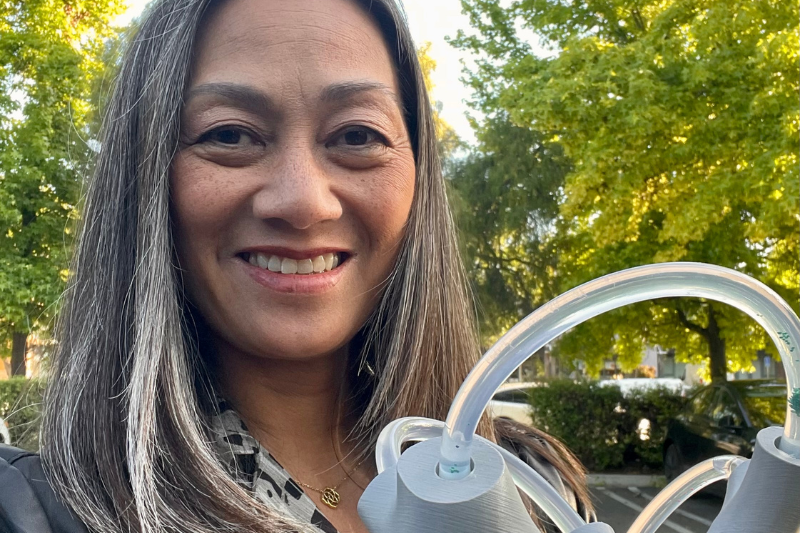
And then I do positional testing for loose crystals from BPPV. I use infrared goggles with a built-in camera — it's dark, but I can still see exactly what your eyes are doing — and I put you through specific positions. Where the crystals are loose determines the exact pattern of eye movement I'll see. It is very precise. And it tells me what we're working with.
Then I talk you through what I found, what it means, what we're going to do and what exercises and relaxation techniques to start with. Education is as much a part of treatment as any exercise I could give you. People heal faster when they understand what's happening in their body. Fear makes everything worse. Understanding is genuinely therapeutic.
You're mobile, and you can often see people sooner than a clinic. Who does that model serve really well?
Honestly, almost anyone who is actively symptomatic and doesn't want to wait 2-3 months to be seen. When you're dizzy and scared to move, the last thing you need is to figure out how to get yourself into a car, navigate a parking lot, and sit in a waiting room. I've had patients in the clinic throw up from a maneuver and need to call someone to come get them because they couldn't drive home. With mobile visits, that's not a problem. You're already home.
I see a lot of working moms who cannot carve out two hours for a round-trip clinic visit. I've seen patients in conference rooms at tech companies because they simply don't have the capacity to step away for that long. I've treated people in their backyards, walked patients down their street because they were scared of slopes and curbs and we needed to practice in the real environment. I've met people at parks. Whatever the situation calls for.
Postpartum moms who can't drive and can't easily leave. People managing young kids at home. People caring for elderly parents. And very practically — if I'm going to teach you a repositioning maneuver to do on your own, it is so much more useful to do it on your bed, figure out the right orientation, and practice it right there than to learn it on a clinic table and then try to replicate it at home.
I bring my own equipment. Everything I need comes with me. There are almost no restrictions on what I can assess or treat in the home.
Some doctors literally tell their patients to take a picture of your card and call you. What do you think builds that kind of trust with other providers?
Relationship and results, honestly. I spent years in the hospital building credibility with the hospitalists I worked alongside — evaluating their patients, communicating my findings, making treatment recommendations, and following up. They saw what happened when vestibular patients got appropriate care versus when they got a walker and a pamphlet. That trust built over time.
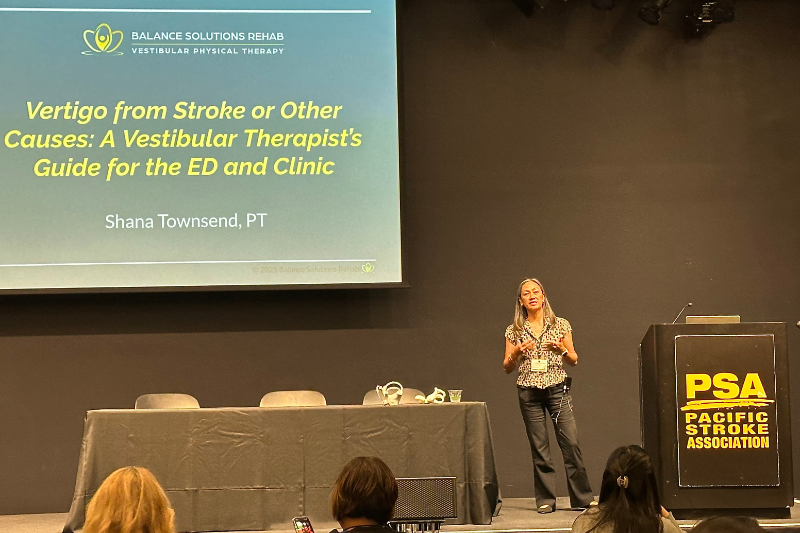
When I started my own practice, I set up meetings with concierge practices and primary care groups across the South Bay and Peninsula. I went in and taught them — here's what's happening in this tiny organ, here's what to look for, here's what a good referral looks like. Most doctors get minimal vestibular education in medical school: do an Epley maneuver, prescribe Meclizine, move on. I've given a talk at a stroke conference about the different presentations of vestibular symptoms in the ER, specifically because too many people leave the emergency department with nothing — no diagnosis, no referral, just a prescription for a medication that often doesn't work and can actually increase fall risk in older patients or are told to look up exercises or maneuvers on YouTube without proper guidance.
The more providers can recognize what they're seeing, the better they can match patients to the right specialist. I'm not the only person on this team. But I want every doctor in my network to know when to send someone to me.
You brought up the hair salon basin, reclining at the dentist, and even picking a golf ball out of the hole. What are some triggers people don't connect to vestibular issues, and what should someone do in the moment if the room starts spinning?
Benign Paroxysmal Positional Vertigo (BPPV) is triggered by head movement in relation to gravity, and it shows up in so many places people don't expect. The dentist chair reclining. Lying back to get your hair washed. Rolling over in bed at 2am to go to the bathroom. Picking something up off the floor. Looking up to change a lightbulb. Bench press. Downward dog.
Most importantly, find someone like me to help you get those crystals back where they belong. This is the recommended and only treatment. Too often, physicians will prescribe a “dizzy pill,” called Meclizine, and tell you the vertigo will go away with time. Or they tell you to look up a maneuver on YouTube. Please, find a specialist who can correctly diagnose and treat you so you can move however you want, however fast you want, without thinking about it at all.
But in the moment, or while you’re waiting to see a specialist, I want people to know is that if it's positional, it will stop. If you get to the dentist and the chair tips back and the room starts going — breathe. Stay in position, let it settle. It will resolve within a minute. Once it stops, the dentist can work on your teeth. If you need to be reclined for a procedure and know your crystals are loose, just tell the dentist to go slowly in both directions. Slow movement through the trigger position means the crystals shift gradually instead of cascading all at once.
If you're bending over and you know things might move, keep your head above your shoulders. You can still squat down and pick something up — just keep your head neutral and upright, not tipped toward the floor. Move carefully, move slowly, stay calm. Then give me a call.
Women seem to be disproportionately affected by vestibular issues. Is that a care-seeking thing, or is there something biological happening?
There is real biology behind it. BPPV — the crystal problem — affects women more than men for some of the same reasons osteoporosis does. The crystals are made of calcium carbonate. When estrogen drops during perimenopause, calcium metabolism is affected, the crystals become less sticky, more brittle, more likely to break free. It happens to men too, but not at the same rates.
And vestibular migraine is significantly more common in women. The ratio is roughly four to one. Migraine is a chronic neurological condition with a strong hormonal component — it often activates around puberty and intensifies around perimenopause, which can start showing up in your 30s and last for 15 years. It can morph over time. Someone who had traditional migraines as a teenager, had a good stretch in their 20s, and then suddenly starts having unexplained dizzy episodes in their late-30s — that's a story I hear constantly.
I've treated a 16-year-old who had his first vestibular migraine during AP exams — stress-triggered, family history of migraine, and he spent his 20s seeing specialist after specialist without a diagnosis. I've worked with women who stopped driving, left jobs, went on disability. Vestibular migraine is real, it is underdiagnosed, and it is treatable. The hormonal connection is also why I pay close attention when younger patients have early-onset BPPV — in your 30s, that often signals something underlying. Migraine, hypertension, high cholesterol, diabetes. It is worth looking at the full picture.

What's a green flag that vestibular rehab can help, and what's a red flag that means go get medical care right now?
The greenest flag is positional vertigo that follows a clear pattern. It only happens when you move your head in relation to gravity — lying down, rolling over, sitting up, bending, looking up. It lasts less than a minute, stops when you hold still, and comes back when you move again. That is BPPV. It is a physical problem and it is very treatable. Those are my easiest cases. We put the marble back in the maze and send you on your way.
The red flag is first-time vertigo that won't stop. Not 20 seconds. Not a minute. We're talking ten, twenty minutes or hours of continuous spinning, trouble walking, vomiting — and it's the first time you've ever experienced this. That needs a medical evaluation. First-time persistent vertigo can be a stroke. B.E. F.A.S.T. is an acronym for recognizing stroke symptoms:
B - BALANCE: sudden loss of balance, coordination, vertigo or headache?
E - EYES: sudden change in vision (blurred, loss or double vision)?
F - FACE: does one side of the face droop?
A- ARM: is one arm or leg weak or numb?
S- SPEECH: is speech slurred or strange?
T- TIME: time to call 9-1-1 immediately!
It can also be a vestibular migraine or an inner ear infection — neither is life-threatening, but they can feel identical in the moment. You cannot tell the difference without evaluation, and you do not want to wait on the stroke possibility. Go to the ER. Rule out the dangerous things first. Once you have that clearance, come find me.
What are the wins that remind you why you do this?
I had a patient in her 40s — tech career, high stress, and she'd had a lot hit her at once. A family death, a major trip and getting passed up for a promotion she'd been told was hers. She experienced her first vestibular migraine on the airplane coming home. By the time she found me, she was walking with a walker and holding her husband's arm.
Her nervous system was so dysregulated that she had essentially stopped trusting her own body to hold her up. We spent a lot of the early sessions not on exercises, but on calming. Grounding. Teaching her that the ground was actually there and it was safe. Teaching her to trust what her feet were telling her instead of white-knuckling everything through her eyes.
About a month in, something clicked. I had her walk two steps with her eyes open, then two steps with her eyes closed. Then three, then four, then five. And her husband, who was standing behind her watching, said — I cannot tell when her eyes are open or closed. She looked the same either way. That was the session I thought: she can go to Australia.
She'd asked me in October whether she could make a December trip. She went. She climbed the Sydney Harbor Bridge. She went zip-lining. She still had dizzy episodes here and there, but she knew what they were, she knew what to do, and they no longer owned her life. She has since gotten the promotion. She's doing great.
That is the goal. Not perfection. Not a guarantee that it never comes back. But understanding your body, having a rescue toolkit, and not being afraid anymore. That changes everything. She was my inspiration for climbing the Sydney Bridge when I went to Australia last year.

If a mom is reading this and thinking, "this sounds like me" — or her partner, or her parent — what's the one thing you want her to know, and what should she actually do this week?
I want her to know that how things feel right now is not how they have to feel forever. Dizziness is one of the most treatable and most under-treated conditions I know of. People suffer for years — sometimes decades — without ever getting the right care or even the right words for what's happening to them. That doesn't have to be her story.
The smartest first step she can take is to reach out, even just to talk. My free discovery calls regularly turn into 30 or 45 minutes because there is a lot to unpack, and I genuinely want to understand what's going on before anything else. If I can help, I will tell you how. If what you're describing is better served by a neurologist or ENT, I will tell you that too and point you in the right direction. And if you're outside the Bay Area, I offer telehealth for education, symptom management, and trigger strategy — a lot of vestibular work, especially around migraine, does not require me to be in the room with you.
You can find Shana and book a free discovery call at balancesolutionsrehab.com.
Connect with Shana Townsend on LinkedIn, Facebook or Instagram.
You can also find her on The M List, The Mamahood's searchable database of mom-recommended resources, or connect and collaborate with Shana inside The Club membership for women Founders.