Amanda Taylor on Wealth, Ownership, and Why Women Need to Be in the Room
Interview by Heather Anderson

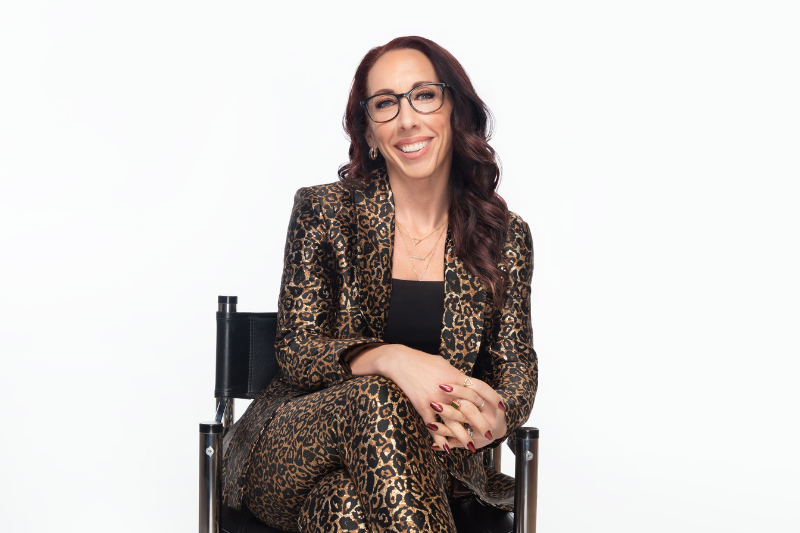
Amanda Taylor spent years building businesses and helping others run theirs before she turned the lens on her own financial life and realized she had handed the wheel to someone else. Now the founder of Metropolis Enterprises and the Expand Your Empire community, she works with women business owners who are great at making money but haven't yet made it work for them. She is also an international keynote speaker, podcast host, and someone who will tell you, calmly and without a hint of judgment, exactly why your money is quietly disappearing.
You shared that after a 22-year marriage ended, you realized you had outsourced your financial future. What did that realization actually look and feel like?
In my marriage, whenever it was time to sit down with our financial planner, my answer was always the same: no, you handle it. At the time, was I giving away my power? Was it because I didn't think I was qualified? I'm not sure what was underneath it, but I never questioned it once. I just assumed that was the way it was done.
Then I got into real estate investing, and the shift started. I got curious. I wanted to be part of those conversations and make decisions, and I was met with resistance. That financial authority had become a position worth protecting in my relationship. It wasn't the only reason for the divorce, but it was part of it.
“No one was coming to save me. Everything I had put on someone else was gone. So this became: I’m it. I rely on me. I have to figure all of this out.”
And after, I realized he was employed with a retirement plan. I was self-employed with nothing. No one was coming to save me. Everything I had put on someone else was gone. So this became: I'm it. I rely on me. I have to figure all of this out. And it wasn't just a house flip here or there anymore. It became: how do I set my life up for wealth, security, and the future I actually want?
You went from managing dental practices to speaking internationally about wealth and business ownership. What were the chapters in between?
I accidentally fell into real estate investing, working about five hours a week as an assistant to two guys, literally googling terms under the table so they wouldn't know I had no idea what they were talking about. That turned into full-time project management, and then my own house flips, and then the realization that there was a whole world I had never been made aware of.
I started to see that so many small business owners had no retirement plan. If I could help them learn how to invest, they'd have a different income stream and a different future. That was one piece.
Then I saw that less than 2% of global venture capital was going to female-owned businesses. I was the only woman in most of the investor rooms I was in. I wanted to know why. And whether it was fear, or women being told they didn't belong there, I knew I wanted to get loud about it. Not just that women need to be in the room, but that they deserve to be in the room. And if they don't feel qualified yet, I want to help them get curious, start learning, and step into that.
You talk about helping women own both their wealth and their worth. For the moms reading this, why do those two things get so tangled up?
For generations, women have been told where they're allowed to stand, how visible they're supposed to be, how much influence they can hold before it makes someone else uncomfortable. We've absorbed that through culture, religion, family dynamics, watching the women who came before us.
The imposter syndrome is real. The self-worth problems are real. And when we carry that deep in our nervous system, when we get access to money or wealth or assets, if we don't feel worthy, if we don't feel capable, we'll miss the full opportunity for impact. The worth has to be there for the wealth to be created, multiplied, and put to good work. You can't separate them.
A lot of women are excellent at generating revenue but still feel like the money just disappears. What's usually going on there?
From a business perspective, a lot of businesses reach a certain revenue point and they're spending more to get there every month. That's just a profit problem. But it happens in life too.
I talk about your investable surplus, but if you save it for last, other things will take it. Anything will take it. DoorDash, shoes, whatever your thing is. It gets eaten away without you noticing because you're not taking decisive action first. That's not a fault. It's just a skill that hasn't been built yet.
In business, it's learning to manage your cash flow, your profit margins, building systems that help you keep more of what you make. In life, it's creating systems for your own financial surplus: how you pay your bills, how you pay your taxes, what goes toward investments, and then whatever is left over is for DoorDash.
I don't preach from the top of the mountain. I do it because I've climbed it. I took the long way up, and I'm trying to help others go around.
Not every business strategist also talks about building wealth outside the business. Why is that distinction so important to you?
We always talk about grow the business, grow the business, grow the business. But fewer than 80% of businesses listed for sale ever actually sell, and of those that do, they sell for less than half the asking price.
If your only exit plan is to sell the business, the odds are not in your favor. So I hope, I truly hope, your business is your unicorn and you sell for 10x. And while you're building it, I hope you are also setting yourself up for assets and investments that cash flow and appreciate and pay you whether you show up to work that day or not.

You help business owners move from being the operator to becoming the owner. How does someone know they're still stuck in operator mode?
You feel it in your bones at the end of the day. Or you don't even have an end of the day.
You've created a really expensive job for yourself, and that's where you have to start. Every business starts there. But it should never be where you stay. The capacity to scale your business is not you. You are one person.
So part of it is tactical: hiring, systems, automation, delegation. But it's nervous system work and ego work too. I was raised that work equals worth. If I'm not hustling, I must not be working hard enough. If I'm not touching every part of my business, every day, something must be wrong. There's a lot to undo there. So we look at both sides: how have you structured this thing, and have you really let go of what you could let go of?
Who do you feel most called to help right now?
People who are ready to grow. I don't care where they are in their journey, but if they know they want to get to the next level, those are my people.
I am for the person who's humble enough to ask for help, take it, and try it, even when it's uncomfortable. Even when their way feels like the right way. You can't read the label from inside the jar. If you've been inside your business long enough, you can't see what other people see, and you need to trust an outside perspective.
There's a lot of nervous system work happening in this space right now, and none of it is wrong. I've done it all: tapping, breathwork, hypnotherapy. But there has to be action behind it. I want the people who are ready to do the work now.
You describe yourself as a fractional C-suite for growing businesses. What does that actually mean day to day?
When you started your business, you did it to do the thing you love, the thing you're passionate about and would do even if no one paid you. I come in and do the rest of the stuff it takes to run the business. The numbers nobody wants to look at. The systems nobody wants to build. The technology nobody wants to implement. The pricing structures nobody wants to analyze. All the things about the business of running a business.
You believe the business is a founder's first asset, but not her only one. How do those two things fit together?
They can't be separated, in my mind. Your business is your first asset. But it should never be your only one, and so I want to help you expand beyond it. If you're working that hard to build something, you should be building something else alongside it that grows whether you show up or not.
I'm agnostic to what that is. I love real estate, that's where I started. But I just want you putting your money in something that cash flows and appreciates. Something beyond the typical 401K or money market. There is so much more out there that people aren't aware of, and I want to be the megaphone for that.
You've said women have been taught to be "responsible" with money, but not powerful with it. What's the difference?
That's my entire platform.
Finance and investing have been wrapped in language designed to make them feel exclusive. And that was not an accident. The system benefits from keeping us dependent. So we've been trained to clip coupons, not buy those shoes, not go on that vacation. We were never told what we could actually do with this stuff.
It's a feminist issue, and I don't come at that from an angry place. It's just that women have been told for centuries that capital is not our space. We produce, we support, we hold everything together behind the scenes. But we're moving into a period of history that's never existed before. Women are on track to control roughly two thirds of global wealth. And if we don't know what to do with it, we're going to default right back to what we were taught. We're going to hand it to someone else and assume someone more qualified should manage it.
I'm trying to prevent that. Women have the capacity to do this. It just takes new skills, and it's not as hard as they've made it sound.
For the mom who hears words like "capital" or "portfolio" and immediately wants to run away, where do you begin?
There's a bit from The Office where Michael Scott doesn't understand the budget surplus, so he asks Oscar to explain it like he's five. Oscar sits him down with a lemonade stand analogy.
That's why I created my Investing 101 course. I wanted to take all the vocabulary, leverage, arbitrage, all of it, and break it down into plain English so it's not scary or intimidating anymore. We can make it make sense.
Can you walk us through what your work actually looks like with two different founders?
A business owner doing everything herself: she's answering every email, onboarding every client, managing every complaint, building every funnel. She's duct-taped it all together because she had to, and she's good at it. But she's hit a ceiling because her capacity cannot scale her business. She's on a hamster wheel of repetitive tasks, just getting to the next thing.
I come in and we look at everything she's doing. Eighty percent of what she does every day could probably be automated. Her pricing is almost certainly too low. Her tech stack is probably a mess. We have real conversations about where she is, where she wants to go, where the gaps are, and how to close them without spending more on marketing or building new funnels. I fix the foundation so she can scale from there.
On the other end, I just brought on a client yesterday who's over $3 million in revenue and can't tell you what his profit margin is. He's a commercial electrician. He says, "I just have to pay my guys." And I'm looking at his numbers thinking: there is so much here. But that's the thing. We build a business and we just keep going, because that's all we know how to do. We never take a breath and ask if there's a better way. I come in and find it.
You teach founders that giving up equity is often not the smartest first move. When might borrowing money actually be the more strategic path?
Shark Tank gave us a false picture of how businesses should get money. Not every business with a product should go find investors.
Debt is cheaper than equity. You probably don't have quite as investable a business as you think yet, and there is so much you could do on your own if you just knew what tools were available. You'd have more control of your business and keep more of what you make. Because when you bring on capital partners, they are taking a piece of your company. When you're starting out, whatever you have to give away feels small. Wait until you've grown to $5 million and they're taking 40 percent of your profit.
There's a tipping point depending on where you are and where you want to go. Investors and equity partners can be the right move in the right circumstances, especially if they bring real expertise and networks that accelerate your growth. But evaluate it carefully. Pay for speed, always. Just make sure you know what that speed is actually costing you.
Women are starting more businesses, earning more degrees, and generating more income than ever before, yet still own a tiny fraction of the equity. That gap clearly fuels you. What are you doing about it?
Women currently hold less than a third of global wealth. Women are 6% of founders and hold only 3% of founder equity. That doesn't make sense to me.
That's why I started my podcast. That's why I speak on stages around the world. That's why I have a magazine and try to get this message everywhere I can. I want to talk about where we are candidly, not to shame anyone, not to make anyone feel bad, but to wake people up so we can rise together.
And there is a massive wealth transfer coming. Women are going to inherit and accumulate capital in a way that has never happened in history. If we're not prepared for it, we're going to default right back to handing it to someone else. That's what I'm trying to prevent.
For the woman reading this who has made good money but still doesn't feel secure or strategic with it, what's one first move you'd want her to make this month?
Get your money out of a traditional bank savings account. It's being eaten by inflation every single day. Your Chase savings account is earning you about 0.01% interest while inflation chips away at the purchasing power of every dollar in there. At the bare minimum, move it to a high-yield savings account. That is the first step.
And zooming all the way out: if everything you're building actually works the way you hope, what changes about the world?
Women are collaborative. We invest in communities, in the environment, in healthcare, in systems that make the world better. We invest in each other and in families.
When women control capital, the world is a different place. I'm building an army of women who are ready to change the world with their wealth. That is what I'm after. Bottom line.

Where can people find you and work with you?
The best place to start is ExpandYourEmpire.org, where you can learn about the community, the programs, and the podcast. I work with founders at all stages, whether you are just starting to think about profit and wealth strategy, scaling toward a real exit, or ready to start investing beyond your business. If you're not sure where to begin, come say hello.
Website: expandyourempire.org
Catch her Podcast: Expand Your Empire, available on Spotify, YouTube and Apple Podcasts.
Connect with Amanda Taylor on Facebook, LinkedIn or Instagram.
You can also find her on The M List, The Mamahood's searchable database of mom-recommended resources, or connect and collaborate with Amanda Taylor inside The Club membership for women Founders.