Shahla Fisher De Leon on Preemie Parent Support and Soil & Sprout Perinatal
Interview by Heather Anderson

Shahla Fisher De Leon is a doula, preemie parent coach, and founder of Soil & Sprout Perinatal, a Bay Area practice supporting families through and after a NICU stay. She spent fifteen years as a strategy and evaluation consultant helping health systems and nonprofits serve people better. Then her own son arrived early, and none of those credentials made it any easier. This conversation is about what she learned on the floor of her living room, and what she built from it.
Becoming a parent didn't look anything like what you expected. Take me back to the moment that really hit you.
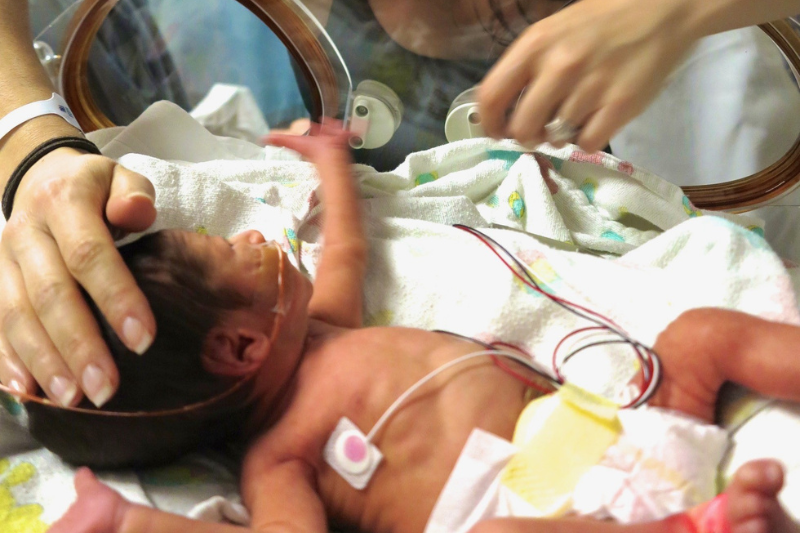
I like to say that being a preemie parent is going from expecting to not what you were expecting. I was picturing a maternity photo shoot, the crib set up, the house ready, all of these things that just didn't happen. When I realized I was delivering prematurely, I knew the journey would look different than it does with a full-term baby. What I didn't realize was that it wouldn't end at discharge. I was parenting a medically complex child, and what that demanded of me emotionally, physically, financially, and logistically was just different from anything I'd envisioned.
The clearest example is the moms group I imagined. I pictured all of us sitting around breastfeeding our babies, laughing, comparing milestones. Being in circles like that turned out to be more trouble than it was worth. I had the kid who wouldn't latch. He wasn't portable. We needed the pump and the ice packs and the refrigerated bottles and the formula to fortify, and then you have to wash all of it. Leaving the house was so difficult that my life got very small. In some ways that was lonely, and it was something I had to learn to navigate.
You've called preemie parenthood "the sorority no one ever wants to join." What does that community give people that nothing else can?
Understanding, more than anything. Nothing takes away the hard, and that isn't really the point. But there are parts of having a NICU baby that people just don't get unless they've lived it.
Here's an example. The biggest thing I'd want every preemie parent to know is that it's not your fault. Your body's not broken. And yet I try very hard not to say that to people, because I'm a pretty sharp cookie, and I knew cognitively that it wasn't my fault, and it didn't matter. Something in my bones felt otherwise. Someone can tell you a hundred times and it doesn't translate into being able to feel it. Hopefully that comes, but it has to come from inside. So what I can do is hold space for that.
The other thing is that the people around us, when we deliver early, don't know what to say. It's this weird mashup of celebratory and terrifying and sometimes tragic, and "congratulations" is wildly inadequate. So people reach for comfort, and it's a trap. I call them the "at leasts." At least you can go home and rest. At least you didn't have to, and fill in whatever comes next. They're all bad. If you're about to say something to a preemie parent and it starts with "at least," stop, rewind, don't.
I've thought a lot about why that happens, and I think it's that other people are managing their own discomfort with our pain. The people who love us most are trying to erase it because it's agonizing to watch us grieve. That's about them. What we need is not to be cured or fixed or sanitized. We need to be witnessed, held, seen, and acknowledged. That's what this club nobody signs up for gives you. You're not alone, and you're seen by someone who actually knows.
“Babies and children thrive when their caregivers are resourced, nourished, and nurtured. When you water a plant, you don’t water the rose at the tip of the bush. You water the soil.”
When support did show up for you, what did it look like?
People came out of the woodwork. My godmother had her first baby in the NICU, and one day she just showed up at ours. An acquaintance from high school, someone I only knew on Facebook, messaged and asked if I wanted to talk, and that phone call meant more than she probably knows. A friend of my parents brought me a NICU care package with such knowing things in it. Easy magazines for the long hours at the bedside. Really luxe hand cream, because you're washing your hands forty thousand times a day until your skin is ready to peel off your body. A little onesie from their last vacation. A note.
And then strangers. You're in the checkout line and someone asks how old your baby is, and suddenly it's a complicated question. Do they want the short version or the real one? But every once in a while, when you explain adjusted age and actual age, they tell you their son was a preemie, or their husband was, and he's six foot six now and doing great. That's how I realized this sorority really exists. It's gender inclusive, because not everyone who gives birth identifies as a woman, but something unites us.
It's the antidote to a very specific grief. If birth is natural, if mothering is natural, if feeding and growing babies is natural, then I failed. My baby couldn't feed, breathe, or hold his temperature on his own. As far as nature goes, he was not selected for survival, and that's shocking and dark. But I've come to find it oddly peaceful. Nature is brutal. Nature is all the things. I'm from Berkeley, I wanted the divine feminine experience with the angel baby at my breast, and I felt so robbed. What I got was a nipple shield, a pump, a feeding tube, and a lot of medical intervention that helped my kid survive. Historically, a lot of babies died. A lot of mamas died. I'm grateful for my baby. I'm grateful for our survival.
In 2025 you lost the consulting job you'd built over fifteen years. How did that end up pointing you toward this work?
I have to go back further. My career started at Planned Parenthood, so reproductive health and justice has always been part of my work. I wanted to work at a systems level, so I got my master's in public health and landed a consulting job helping foundations, nonprofits, and government organizations make their work more effective, more equitable, more trauma-informed. It's my jam. It's still my jam. But maternal and infant health was maybe fifteen percent of my portfolio, and I was craving for it to be a hundred.
Meanwhile, over on the personal side of the house, my first biological baby was born prematurely, and it totally kicked my ass. I had a master's in public health. I'd worked in healthcare. I had written the academic papers on the benefits of breastfeeding. It did not matter. I was white-knuckling my way through one of the hardest experiences of my life. That pushed me into peer mentoring and advisory councils, a March of Dimes conference that cemented everything, and doula training in 2024, all while still working full time. I gave myself no-strings permission to do the training. It'll make me a better consultant, I told myself. Then I was stuck with the question of how you serve as a doula on top of a big career, and I didn't have an answer.
Then the universe delivered. One minute I didn't have time to pour myself into this thing, and the next minute I did. Getting laid off was the blessing I never knew I needed and certainly didn't ask for. I went through some real identity shifts. My relationship to time, money, and myself had to change, and I didn't choose that. But I'm grateful. There is nothing like working for yourself when you actually know your purpose, because you get to stay completely mission focused.
You've spent your career helping health systems serve people better. How does that show up when you're sitting with a family in the middle of a NICU stay?
The thing I see clearly is that it's really hard to deliver trauma-informed care from traumatized systems. There's a lot of stress and vicarious trauma in healthcare, and much of it comes down to reimbursement, liability, risk-based medicine, and staffing. Those are policy choices. But the people they land on are frontline staff and patients.
There's a stereotype that doulas and health systems are adversarial, that the doula's job is to push back against systems that harm women. I'm not saying harm doesn't happen. But I can also see how the workforce is being harmed by those same systems, and we all do the best we can. I think of myself as a loving, patient person, and I yell at my kids, and I'm not proud of it. I don't show up as my best when I'm stressed and unsupported. Neither does a nurse.
Here's a concrete example. A lot of NICU parents have moments where their needs aren't met or their care doesn't feel right, and they don't know why. A former NICU nurse who trained me put it this way: the NICU nurse's patient is the baby. The role is medical. And yet a family needs emotional support or answers, and she might have a baby in medical crisis over here and a family in emotional crisis over there, and she cannot be in two places at once. That bind comes from ratios and role design, not a lack of caring. I never want to gaslight someone who received poor treatment. But being able to see the system behind the people, and to look for common ground, can be really helpful when a family is feeling unseen or unsafe. So what I bring is a deep ability to listen and validate, alongside a systems lens that isn't there to villainize anyone.
Most people know what a doula does around a birth. What does a preemie parent coach actually do once the baby is already here?
Some of it looks like what any postpartum doula does. I help the parent prioritize healing and rest, warm food, hydration. I help organize questions before rounds or appointments, and I'm someone to process information with. It's not my job to tell you what to ask or what to do, but to be a partner while you think it through. I also do a lot of what I call helping the helpers be helpful, coaching family members on readjusting tasks and priorities so they line up with what this family needs right now. That might mean talking with grandma, who's wondering why her daughter is so uptight about how things are done. Well, coming out of the NICU, hygiene and timing and documentation genuinely matter with a medically vulnerable baby. Or it might mean I do your Trader Joe's run so you can be at the bedside for care time.
The reason I don't just call myself a NICU doula is that a lot of the hardship doesn't happen in the first twelve weeks. My son was eight months old when he was diagnosed with failure to thrive and got an NG feeding tube at home, which we had until he was eighteen months. That first year or two is appointments and the project management of life with a medically complex child, and it was only then that I could start to grieve and process. So I don't limit myself to the fourth trimester.
Here's the practical piece. Preemies are often not good at feeding. Mine got a gold medal in not good at feeding. We were using a supplemental nursing system, a little tube you tape to your nipple so the baby can get extra milk at the breast, and you need about eight hands to use it. Even once you figure it out, it's one more thing to wash and have ready while your baby is screaming and you're overwhelmed. Everyone sends you home with oral motor exercises eight times a day and feeding thirty-two thousand times a day and pumping and laundry, and you're just like, what? Washing bottles is not rocket science. That's not the point. The point is the difference between "this is a lot" and "this is too much." I don't have to be there 24/7, but I can bring the temperature down and help the whole family hold this delicate little ecosystem so it isn't too much. I don't replace nurses, doctors, or lactation consultants. I refer actively. I'm the glue between the other pieces.
Where does the name Soil & Sprout come from?
Babies and children thrive when their caregivers are resourced, nourished, and nurtured. When you water a plant, you don't water the rose at the tip of the bush. You water the soil. The baby gets everything it needs from the parent, so you tend to the soil.
That idea runs through everything I do beyond direct work with families. I'm a volunteer peer mentor with Postpartum Support International, and I'm part of a research study on peer support during the perinatal period. Perinatal mental health is this hot potato in health systems. Nobody wants to touch it unless they're licensed, because of fear and liability, and yet we have a huge shortage of clinicians. Peer support builds the capacity of people like me, who don't need to be clinicians and are transparent about the boundaries of the role. It's more than nobody, and nobody is what a lot of people have. I also recently led a training hosted by First 5 Alameda County that I cheekily call trauma-informed care for the people who care for the people: parents, and also the nurses, social workers, preschool teachers, and developmental specialists who support them. Caring for the adults who care for the babies isn't a nice extra. It's the whole thing.
Your work is rooted in birth justice. For a mom who's never heard that term, what does it actually look like in a hospital room?
I want to start with the definition, because it comes from SisterSong, a movement led by Black women, and it matters to me to use their words rather than claim it as my own. Reproductive justice is the human right to maintain personal bodily autonomy, have children, not have children, and parent the children we have in safe and sustainable communities. You can't separate birth justice from that. Birth justice is the idea that it should not be up to chance who gets to feel safe, dignified, autonomous, and joyful during pregnancy, birth, and postpartum.
In the room, it looks like being called by your correct pronouns. It looks like someone addressing your partner or support person appropriately, based on who they actually are. It looks like understanding that Black women have higher rates of preterm labor, and that it isn't because anything is inherently wrong with Black bodies. It's because of the way racism affects bodies across a lifetime. And yet nobody wants to be defined by their risk factors. People want to be defined by their wishes, dreams, and needs. So birth justice in the delivery room is about knowing a person deeply, building relational trust, and helping them advocate for what good looks like to them. Not my idea of good. Theirs.
Years ago, as a consultant, I was interviewing folks in Missouri for a birth justice organization, and a Black woman told me she doesn't love the word empowerment, because it isn't about giving power. It's about affirming the power that already exists. Goosebumps. I've adopted that. I don't empower anyone. I'm a loving mirror that affirms the power they already have.
If a friend's baby was just admitted to the NICU and you could only give her one piece of advice, what would it be?
There's no right or wrong way to do the NICU. There is no magic formula for the correct number of hours at the bedside. There are no good or bad NICU parents. Finding a rhythm that lets the whole family system get through this stretch is the goal, and that's going to look different for everyone. No one can take away the scary, and no one can take away the hard. But if you can give yourself permission not to carry guilt on top of it, that's when you get the gold stars.
You also lead birth story sharing circles. Why does telling the story out loud matter as much as living through it?
Because stories live in our bodies long after the thing happened. Birth is this weird, rare exception. If something unusual happens in my day, the first thing I do is call my husband and say, oh my God, I just saw a dog walking on its hind legs in a sweater. Of course we do that. And somehow birth, the most extraordinary thing that ever happens, we just sail right through. Mostly because if there's a surviving child, we're immediately in the motion of parenting.
Giving your story a place to live outside the body doesn't make it any less a part of you. You don't have to let go of anything you don't want to. It just gives it some room to breathe. Sometimes that's saying out loud what you wish had gone differently. Sometimes it's celebrating, in a big way, the things you did that you're proud of, because those live on too. And it doesn't have to be a traumatic birth. Story sharing is for everyone: surrogates, adoptive parents, bereaved parents, full-term parents, parents of multiples, queer parents. There's no expiration date, either. Two years later or ten years later can be a beautiful time to revisit and let the stuck parts settle. I do this one on one and in groups.
Who is this work for, beyond the family who's in the NICU right now?
Anyone moving through a perinatal or early childhood journey who wants more ease, care, and partnership, and the providers and systems who serve them. Parents further out, with kids who have ongoing medical complexity. The loved ones on the outside, too. My husband and my mom were the closest people trying to support me, and neither of them understood the emotional journey I was on. So I do family check-ins, and I'll take a one-off call from someone whose friend just delivered in the NICU and is scared to say the wrong thing or wants to know what to put in the care package. I also train doulas on what it looks like when a client delivers unexpectedly early.
But here's the thing I most need this community to understand. No one is ever going to plan to need me. You hire a birth doula months in advance. Families who land in the NICU don't know they'll need this support until it's already happening. So I need to know a thousand people for the one right person to hear my name in the moment she needs it. Over the last ten years, so many people have reached out to me after a premature birth, because I shared my story publicly and they didn't know who else to turn to. Salsa dance students. A colleague from a decade earlier. A dance mate from another decade. I accept Kaiser and Medi-Cal, and I want every family experiencing a premature birth or NICU stay to know they can have support shaped by what they need, from someone who has lived it. What I need is more people who can say, hey, you know what? I know a person.

Okay, random, but I have to ask. Outside of Soil & Sprout, you also run a martial arts school with your husband. What's a five-foot-two doula with a history of back pain doing teaching martial arts?
I married my way into that one. After half a decade married to a grandmaster, and wanting our kids to train, I started training alongside my older kiddos and discovered that I love it. And in loving it, I realized how profound it is for people like me, who never saw themselves in who they thought martial arts was for, to have access to it. So I specialize in adult beginners, especially women who aren't gym rats and didn't start Taekwondo at six. We also have parent and kid duos who train together, because one of the biggest barriers to exercise as a parent is what to do with your kids. At our school, we're responsible for the child. The parent gets to be the student. Honestly, it's not so different from what I'd tell someone in birth. Your body can endure more than you think, pain does not always equal harm, you are powerful, and you deserve to feel safe in your body.

If a mom reading this recognizes herself in what you've described, what do you want her to do next?
First, I want her to take a deep breath all the way in and let it all the way out. Just by being here, by recognizing herself in this, she is already strong, already doing something hard, and already deserving of care and support. Then I want her to book a free 20-minute consult and let herself find out what shoulder-to-shoulder support can make possible.
Book a free 20-minute consult with Shahla at Soil & Sprout Perinatal
Learn more about preemie parent coaching and birth story sharing at soilandsproutperinatal.com
Providers, doulas, and organizations: reach out about trainings, speaking, and referral partnerships
Know someone whose baby just arrived early? Send them this article, or send Shahla their way
Explore martial arts in Concord - Learn with MO’O Ryu Kempo Halau O Deleon
Connect with Shahla Fisher De Leon on Facebook or Instagram.
You can also find her on The M List, The Mamahood's searchable database of mom-recommended resources, or connect and collaborate with Shahla inside The Club membership for women Founders.