Berkeley Hypnotist Marina Garcia Wants You to Know That Change Doesn't Have to Take Years
Interview by Heather Anderson
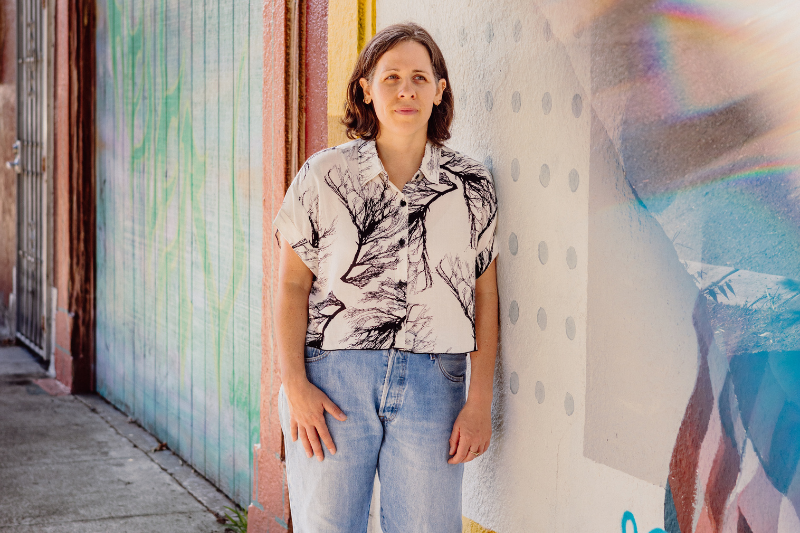
Marina Garcia is a certified hypnotist based in Berkeley, working with clients across the East Bay and online around the world. She helps people change the habitual patterns behind anxiety, phobias, emotional eating, sleep struggles, and more by teaching them to use their minds to rewire their own brains. We talked with Marina about what actually happens in a hypnotherapy session, why the people who have "done years of therapy" are often her best-fit clients, and the surprising speed at which real change can happen.
A lot of people have heard of hypnosis but aren't quite sure what it actually does. How would you describe your work to someone who's curious but a little skeptical?
People typically come to see me because they want to create change in their life. They want to start doing something, or they want to stop doing something, or they want to transcend something. Hypnosis is a way to communicate with the unconscious, so that your conscious desire for change becomes congruent with the way your unconscious is currently functioning. The conscious mind and the unconscious mind get on the same page.
The hypnotic state, or trance state, is mainly just a focused state of awareness. As human beings, we're very used to being in it. It's a state we drop into throughout our day, when we zone out listening to a song and drift into a memory, when we're sitting on a train looking out the window, when we're watching a movie. So this is somewhere we're already quite comfortable going. In hypnotherapy, we use that state on purpose, because it's a highly suggestible state and a really beautiful place to create change from. We go in with clear goals, this is what I want to change, and then we use the state to change it.
“We’re building new neural networks in the brain so you can do what you actually want to do. I’m teaching my clients how to self-direct their own neuroplasticity.”
You talk about helping people identify and change "habitual patterns." What does that mean in practice, and why are those patterns so hard to break on our own?
I frame whatever people come to work on as a habit. Someone might say, I have all this anxiety. Okay, we're going to work on the anxiety habit. Someone else says, whenever I'm stressed out, I overeat. Okay, the overeating habit. Whatever it is, that's the habit.
The idea is that there are neural pathways in the brain that are well worn. There's a kind of if-this-then-that wiring. I often give the example of the person who says, I have so much anxiety, and when we really get to talking, it boils down to, the anxiety shows up at work, and actually it spikes when I see my boss's face. So there's a neural pathway in your brain that says, if I see my boss's face, then I do anxiety. We work together in a co-creative way to teach your brain a new resource state. There's always going to be the if. Now it becomes, if I see my boss's face, then I do peaceful, calm, and relaxed, or whatever it is that the client is going for. We're building new neural networks in the brain so you can do what you actually want to do. I'm teaching my clients how to self-direct their own neuroplasticity.
You came to this work through your own experience with hypnotherapy. What was the habit you were trying to break, and what happened when you finally worked with a hypnotherapist?
For a period of my life, I smoked pot every day, and I came to a point where I realized, this is not serving me. I was struggling with walking away from it. I'd been going to a regular meditation group where I met a hypnotherapist, and I kept his card for a while. Eventually I thought, you know what, I wonder if he could help me. So I started working with him, and I just fell in love with the work. I remember feeling envious that he got to work with people in that way.
A couple of years later, I hurt my knee skiing and was laying around feeling sad and sorry for myself, and it just popped into my head, this would be a great time to start studying hypnotherapy. Everything had gone online at that point with Covid, so I was able to start studying and working with people online, and I've been doing this work ever since.
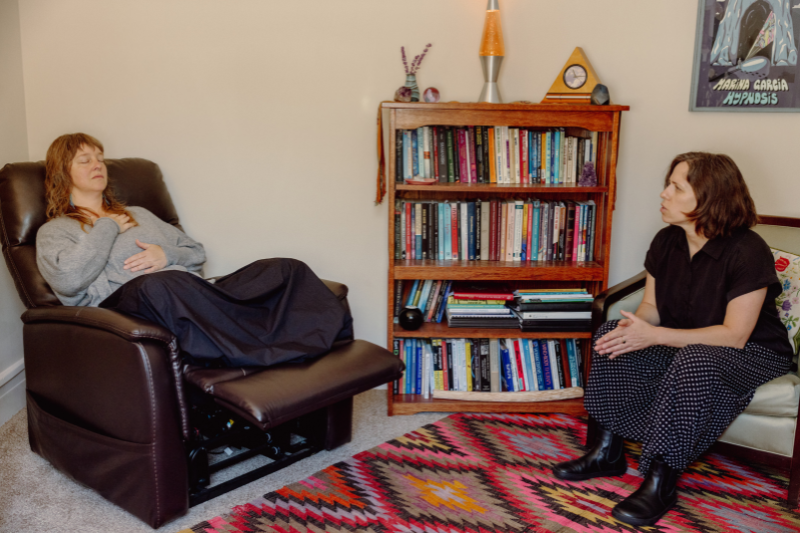
What typically brings someone to your door, and what does a first session with you actually look like?
People come to me for all kinds of reasons, but usually they've tried a lot of different things and they're just not getting traction. Then there's the person who's done a lot of therapy, and they've talked about it to the point where they know all their triggers and they know what their baggage is, but they want to transcend it. I did plenty of talk therapy myself, and I used to describe it as feeling like I was standing in a room with all of my baggage and I didn't know what to do with it. With hypnotherapy, I could move on in a way that I couldn’t before. People come to me because they're ready to move on too. They're done talking about it, and they want change that feels different from just understanding it. They want to see changes in their actions, their reactions, their behaviours, their patterns.
My first sessions are about two hours, and returning sessions are about an hour and 15 minutes. I also do Past Life Regressions, which are about an hour and a half. In the first session, we get clear on the specific habit you want to work on. Some people come in with one thing. I've got a fear of flying and a 16-hour flight this summer, I've got to get on top of this. Other people see this as a way to peel back the onion on a variety of things. Either way, we pick one habit to start with. Then I find out the triggers. When does your brain know, okay, it's time to do the anxiety habit? Nobody feels anxiety all the time, certain things get it going, and we get really clear on what those are. Then we do the work.
Between the first and second session, all the client does is pay attention to those triggers and notice whether anything is changing. Some people come back and say, wow, I'm not even responding to those triggers anymore. Others say, ooh, that one trigger still needs some troubleshooting, and in the second session we go deeper. I tell people it's going to be like either a light switch or a dimmer switch. For some people the change is really fast, and for others it's a slower, progressive process.
I worked with a client a few years ago whose teens had been in a car accident, and for many years after that, she carried all this fear about driving on the freeway. She'd gone to multiple talk therapists and just couldn't create any change around it. We did one session, and when she came back she said, oh yeah, I can do that now, no big deal. Let's work on when my husband drives, that still makes me nervous. It was just that fast. I never know how it's going to go, and I'm always hoping it's fast, because I personally want change quickly for myself. There's no pressure on it, though. Everybody is their own unique individual, and I always say there's a little mystery to this work.
You work with anxiety, emotional eating, pain management, sleep, phobias. It's a wide range. Is there a common thread in the people who come to you?
It's mostly women between the ages of 30 and 60, with definite outliers. Most people who come to see me have already done some form of talk therapy, and they're open to alternative healing modalities. A lot of them also have some connection to something bigger than themselves, a spirituality. For some people that's a specific religion, and for others it's more that they're open to the woo, open to energy, the universe, open to not knowing everything, open to the mystery.
What does hypnotherapy offer that talk therapy doesn't, and how do the two complement each other?
Hypnotherapy is specifically for habit change, and I work with folks in a goal-oriented way. Why are you here? How will we know you're getting what you came for? The metaphor I use is a ship. Where is the destination? We point the ship in a specific direction, and then we chart the progress, because I always want to know, are we going in the desired direction on this?
I also teach self-hypnosis techniques as we go. I have a lot of tools in my tool belt, and clients leave with tools they can use for shifts in the moment. We don't have to stay in the state we're in. You don't have to stay in that high-anxiety state. You can use a whole variety of tools to shift how you're feeling right now. So I look at what I do as part teaching and part in-the-moment change work, supporting, guiding, and partnering to create change. And I see it as short-term work. Whatever the habit is, I'm not looking to work with people for years. It's more like taking your car to the mechanic. You want your car back, and you want to drive it.
Hypnotherapy and talk therapy definitely compliment each other. The way I see it, hypnosis is a tool that talk therapists can use, or they can subcontract it out to people like me. They’ll send me clients who have been really stuck in some habitual pattern and ready to change.
You also offer past life regression sessions, something many people are curious about but don't know how to approach. How do you explain that work?
People can benefit from past life regression sessions even if they don't believe in past lives. You don't need to know that past lives are real. I don't even know if past lives are real. What I do know is that when I go into that state with people, their unconscious is going to show them something that benefits whatever they're working on.
Leading into the session, I keep it open-ended. What do you want some insight around? Is there a pattern in your life you can't quite place? Maybe it's physical, like that shoulder pain you've had forever, or maybe it's an emotional pattern. Then we go in, and I can tell you that every single person I've ever done this with sees or senses something, and learns about themselves. People describe it as watching a movie, and there's a kind of distance to it, a neutrality. I do my best to stay out of the way in these sessions, asking a lot of questions, and guiding people to notice the first answer that pops in. Information comes by seeing, hearing, or feeling, and that first answer is the unconscious response, the intuitive response. Your analyzer will come in and say, maybe I'm doing this wrong, maybe this is just my imagination. Just listen to the first thing that pops in. The people who can really relax and float downstream are the ones who get the most out of it.
What does progress actually look like for your clients? How do people know it's working?
Progress looks like the softening of the edges of your life. Things just get smoother and easier. For some, it means not getting triggered anymore about that thing. Or it means not being triggered for as long anymore. It means being able to let it go more quickly. For others, it’s being able to actually say “No” to the craving. What I've found, personally and with clients, is that people almost forget about the thing they were working on, because they're busy doing other things now and they don't have to worry about it anymore.
When I was first getting into this work as a client, I had this visual of window screens stacked above me, blocking the sun, and I was removing them layer by layer, with more and more sunlight getting into my life. I've always seen it that way. There's this loosening, this softening, this opening up. We have so many patterns and habits we can untangle, and for people who want to go deep and use this across many areas of their life, it's just so transformational.
You describe your favorite clients as "curious minds, creatives, high performers, and anyone playful at heart." What makes that type of person such a good fit?
There's something really creative about this process, and it fits people who are comfortable in a place of creativity, comfortable not having all the answers, trusting the flow of what's coming through. There's a real aspect of play to it. I'll say, I'm going to introduce this tool to you, and it's going to seem so dumb, but let's see if it changes how you feel. Someone who can meet me and play with that is going to get the most out of it. Someone who stays in their head, thinking this is too dumb and simple to create any change, won't get as much.
It's more fun for me to be with people who are open to the mystery, because there's so much to access in the mystery. I'm still learning and exploring. A client once said to me, we're like Lewis and Clark, out on the edges exploring consciousness, and I feel so grateful to have ended up here. It's an honor to go into this dream state with people. I also work with people on an energetic level. I study energy work and I work pretty intuitively, and I see myself as an intuitive guide, helping my clients use their own intuition. We're really working with the wisdom from within them. I'm no expert in anybody's life. Each client is the expert in their own life, and for people open to working that way, it's a really beautiful unfolding.
Outside of your practice, you're into arts and crafts. Collage, painting, mosaics, embroidery. How does that creative life show up in your work with clients?
It comes back to play. I love making things. I love making art with all the little ones in my life, because there's such freedom there. I learn so much from art projects with kids. Nothing has to be right. You're just making art to have fun, and I take that playfulness and flow into my sessions. I come in with my training and specific tools, and I'm also working with what shows up in the moment, speaking to the inner wisdom of the client, their unconscious, their intuition. The way I think of it is like jazz musicians. I'm listening to what you're playing and I'm responding back, playing with you. And it's funny, because in my art, I love making things that look very specific and perfect, and I also love the mistakes, working with the mistakes and seeing how cool those turn out. It’s that improvisation and flexibility that’s really important for this work.
What's one thing you wish more people knew about hypnosis, something that might change their mind about trying it?
That you can use your mind to change your brain. We can actively change our experience with our thoughts and where we direct them. And maybe more simply, I want people to know that change doesn't have to be so hard. Change doesn't have to be complicated, and it doesn't have to take a long time. It can actually happen really quickly.
I was at a wedding a couple of years ago, and my partner and her sister were both really nervous. One was giving a speech and one was officiating. I had 15 minutes with each of them, did some hypnosis, and they both went out and killed it. There was something really special about having just a short window, getting in, helping them create the change within themselves, and then saying, okay, now go do your thing. Change doesn't have to be painful and it doesn’t have to take a long time.

Do you work both virtually and in person?
Both. I have an office in Berkeley near the Berkeley Bowl, and I see people online, with clients throughout the US and in Europe and the UK. This is a big question for people, so I'll say it plainly. Online is 100 percent as effective as in person. I haven't found any difference. It's really a matter of comfort. Some people want to meet me in person to get to know me and the work that way, and some people prefer to close their eyes and turn inward in the comfort of their own home. I even have clients on the other side of the hill who eventually decide they'd rather skip the tunnel traffic. Wherever you feel most comfortable is the right answer.
If someone is reading this and feeling called to explore working with you, what's the best first step?
Schedule a discovery call with me. Go to my website and click on schedule a discovery call. It's a free 15-minute call where we can discuss what it is you're looking to change, I can tell you a bit about how I work, and we can explore if this would be a good fit, because I only move forward with people I believe I can help.
Ready to see what your mind can do?
Schedule a free 15-minute discovery call at marinagarciahypnosis.com or by text 415-416-9189
First sessions are two hours ($350), with returning sessions at 75 minutes ($215) and , past life regressions at 90 minutes ($260)
Connect with Marina Garcia on Instagram.
You can also find Marina Garcia on The M List, The Mamahood's searchable database of mom-recommended resources, or connect and collaborate with Marina inside of The Club membership for women Founders.