Thrive Physical Therapy's Lakshmi Sriramaneni Won't Let "Just Part of Being a Woman" Be the Answer
Interview by Heather Anderson

Lakshmi Sriramaneni is a physical therapist and the founder of Thrive Physical Therapy, a virtual practice focused on pelvic health, pregnancy, and postpartum recovery. Before launching Thrive, she worked in outpatient clinics and spent years in virtual physical therapy, first treating patients and then as a clinical consultant helping build women's health programs at Hinge Health. She built Thrive so women could work with one PT who knows their whole story, on their schedule, without insurance deciding when their care is over.
You became a physical therapist because you watched too many women get told their pain was "just part of being a woman." Was there a moment or a person that made that hit home?
It wasn't one moment. It was something I saw over and over in the clinic. But it really hit home when my friends started having babies. A lot of my friends are at that age right now, having their first or getting ready for their second, and seeing what they go through day to day, outside a healthcare setting, is completely different.
I'd tell them to go talk to their doctor, and they'd come back and say, oh, they said it's normal. And I'd say, no, it's not normal. I used to think that if I told someone that, they'd believe me and come get treatment. But they're convinced it's normal, because so many providers have told them it is. Their friends who've been through pregnancy have normalized it. Their mothers have normalized it. Society has.
With patients, it's harder to push back, because you don't want to contradict another provider. But with my friends, I already have that rapport. I can ask, where did you get this information? Why do you think that? That's why it's more front and center for me now than ever.
You spent years working in clinics before you built Thrive. What did you see there that made you think, this system wasn't built for the kind of care I want to give?
A lot of women come in for something orthopedic, like low back pain. Then, as we get comfortable and I take their history, they open up about pelvic floor issues or diastasis recti, or about never feeling the same since their pregnancy. Sometimes that's ten or more years after their last baby. You see the downstream impact of not getting care, and how often it happens.
Then there's insurance. Say insurance approves 12 sessions. That's about six weeks, twice a week. If you need more, you have to get approval again, and often there's a cap per calendar year, so they'll say it isn't necessary. So women wait until something is wrong, get a little care, start to understand what's going on, and then it ends. It's not enough time to fully treat the issue and learn how to manage it on your own.
And there aren't many PTs who know how to treat women through pregnancy and postpartum. Even if you find one, they're far away or booked up, so you rotate through whoever's available. With issues this sensitive, that matters.
A lot of people hear "virtual physical therapy" and think, how does that even work? Especially for the pelvic floor. When did you first see it actually work?
During my pelvic health rotation in PT school, there were two pelvic floor PTs in the practice. One did the typical internal exams. The other never did. She never had patients remove their clothes, which alone is a big barrier for a lot of women. That's when I realized there was another way to treat pelvic floor issues.
Then COVID hit, and everyone was asking how people were going to get help. Telehealth really got rolling. I joined Hinge Health, which was a startup at the time, with women's health programs for pelvic floor, pregnancy, and postpartum. I worked with a lot of women's health PTs and saw how differently everyone treated patients without seeing them in person, and I watched huge numbers of women get better. That's what solidified it for me.
I treated patients virtually there first. Then I moved into clinical consulting, looking at the research, finding the gaps, and helping use the platform to show that virtual PT really works for women's health, pelvic floor, pregnancy, and postpartum.
“That’s every PT’s goal, or it should be: teaching patients to be independent. No one should rely on a healthcare service for the rest of their life.”
What surprises people most once they actually try it?
How little they need to rely on going into a clinic, and how independent they can become. People think PT has to be an hour, twice a week, with the PT's hands on you. Then they try virtual PT, build rapport with their PT, and can reach out during the week as things come up and get strategies right away.
That's every PT's goal, or it should be: teaching patients to be independent. No one should rely on a healthcare service for the rest of their life. Patients start to realize, I can do 30 minutes with Lakshmi, and then I know how to do this on my own for 15 minutes here and there. When I have a flare-up, I can try the strategy she taught me. I don't have to wait three days for a clinic appointment. They get really confident, and PT doesn't feel like it's taking over their life.
Walk us through what it's like to work with you. Someone books. What happens next?
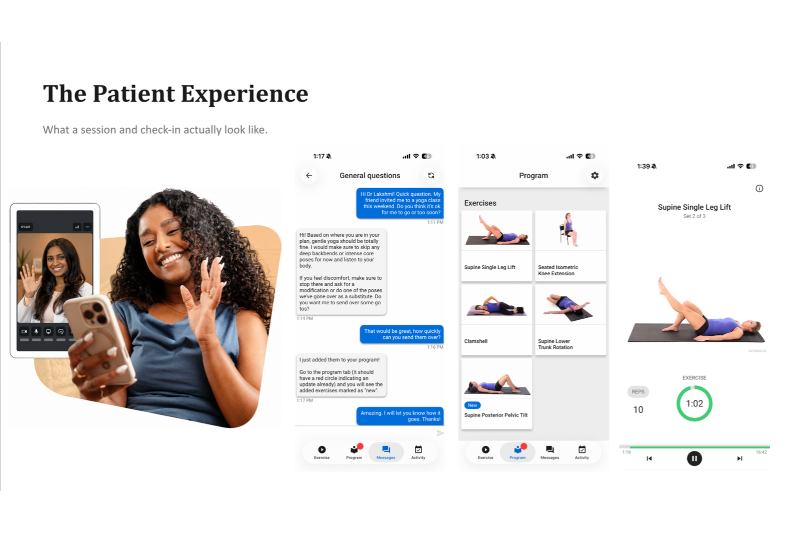
You'll get standard medical intake forms by email, so I understand what's going on, what your goals are, and what your life looks like before we ever meet.
The initial evaluation is the same as it would be in a clinic, except I don’t put my hands on you. First we talk through your history, your concerns, and your goals. Then we do a movement assessment. I never ask anyone to take their clothes off. You stay fully clothed. Reading someone's movement is a skill I've honed even more virtually than I did in the clinic, and combined with what you've told me, it gives us a good picture of what's going on.
Then we build a treatment plan and try a few exercises together. Afterward, you get an email with a link to the app, which has your exercises as videos you can follow along with. You can message me whenever a question comes up, so you have guidance even when we're not doing a live session.
At Thrive, every visit is with the same person who knows your story. Why does that matter so much, especially for someone who's pregnant or just had a baby?
Healthcare is personal, and pregnancy and postpartum are so different for everyone. It's not, “you didn't have a complicated pregnancy, congratulations, here's your baby, go home”. Everybody heals differently. Hormonal shifts affect people differently, emotionally too. People have different levels of support. All of that shapes how much you have to move, how much you can rest, and whether you're going back to work or back to the things you love to do.
Having a PT who knows your whole story means you don't have to recount it to someone new every visit. That makes a clinical coaching model possible. I check in with you every week, between sessions too, so we can figure out how to fit rehab into your actual life. The goal is that you're successful long after you finish working with me.
Let's talk about the six-week postpartum checkup. What does it actually check, and what does it miss?
The six-week checkup is mostly to make sure the acute healing phase is wrapping up and there are no complications. Your uterus needs time to shrink back down, and any tearing and bleeding need to resolve before you're cleared to return to regular activity. That checkup really matters.
But it doesn't assess the actual quality of your core or pelvic floor. Is it tight? Is it weak? Does it contract during the right movements, and relax at the right times? It doesn't check your overall strength or mobility, or any compensations your body made during pregnancy.
For example, a lot of women end up with low back pain. At nine months, your belly is big, so you lean your trunk back to offset the weight pulling you forward. After pregnancy, that extra curve in the low back often stays. We call it lordosis, and it contributes to chronic back pain.
Then you're told to ease back into your activities, and no one tells you how. Take it easy, and when you feel good, go back to normal. What does that mean? What if I don't feel good? What if I feel good, do the thing, and then feel bad? That's literally what happens. Without a real assessment and a plan to pace yourself, you can move too fast, get hurt, or develop a new compensation that shows up as pain ten years later.
What are the things you see in pregnancy and postpartum that women assume they just have to live with?
Urinary incontinence. Pain with sex. Diastasis recti, or just a weakened core that doesn't feel like it used to. I've had women with low back pain or sciatica that started during pregnancy, who were told that happens a lot, and that once you have back pain, you just deal with it for the rest of your life.
Neck and shoulder pain from feeding comes up too. It doesn't usually stick around for years the way back pain and pelvic floor issues do, but who teaches anyone posture for breastfeeding every two hours? No one. You can't not feed your baby. So PT helps with which positions to use, how to manage the load of carrying a baby all day, and what to do when something hurts.
Every woman has a pelvic floor, and most of us couldn't tell you what it does. Give us the quick version, and tell us who this matters for beyond new moms.
Think of your pelvic floor like a bowl. It supports your organs, like your bladder and uterus. It controls your bladder and bowels: you contract it to hold it until you get to the bathroom, then relax it to go. It's part of sexual function. And it's part of your core, which most people don't realize.
Picture your core as a box. The front is your abdominal muscles, the sides are your obliques, the back is your spinal stabilizers, the top is your diaphragm, and the bottom is your pelvic floor. They all work together, and they're deeply connected to breathing. Whether you're lifting, doing diaphragmatic breathing, or learning to push during labor, a compensated pelvic floor affects how well you can do it.
So it matters for expecting moms, new moms, moms who are years out from birth, women in perimenopause and menopause, and athletes. Everyone needs good bladder and bowel control and a stable core. We usually only think about the pelvic floor during pregnancy and postpartum. Really, anyone with back or trunk pain should be evaluated for it too.
What's the pelvic floor myth you'd love to retire forever?
That pelvic floor PT is just Kegels, and if you have a pelvic floor issue, you just need to do more Kegels.
A Kegel is contracting your pelvic floor. But pelvic floor issues can come from tightness, weakness, or coordination problems. If your pelvic floor is already tight, and you read online that you should do Kegels and start doing a bunch of them, you're making it tighter, and you'll make things worse.
The pelvic floor is connected to so much else: hip and spinal mobility, your adductors, glute strength, and diaphragmatic breathing. If one piece isn't working, it affects the others. So learning to relax matters as much as learning to squeeze, and we don't want to assume the problem is just the pelvic floor muscles.
Pain with sex is something a lot of women don't bring up, even with their doctors. How can PT help, and what do you want women to know before they decide it's just how things are now?
It's common, and it's highly treatable. The research on physical therapy for it shows really good results.
In PT, you'll learn exercises to help relax the pelvic floor, and gentle techniques you can use on your own to get comfortable with sensation without the anxiety of anticipating pain. We talk through positions that put the pelvic floor in a more comfortable place while things are still sensitive. And we figure out how to progress slowly, so you're not pushing through something that hurts and making it worse.
Something people don't realize is that your partner can join a session if you want. Sometimes it helps for them to hear it directly from a healthcare provider. If that feels weird, you don't have to. We can keep it just you and me. Either way, there's a lot we can do.
Do people usually need an X-ray or MRI before starting PT?
No. I'd argue you rarely need one before starting PT unless there was a traumatic event, like a fall or car accident that could result in something like a broken bone. Your physical therapist will do a thorough assessment, and if imaging is needed, we'll always refer you. With pregnancy and postpartum pelvic health, I don't think I've ever asked someone to get an X-ray or MRI.
If a mom reading this is dealing with something and can't decide if it's "bad enough" for PT, how does she know it's time to get help?
It never has to get bad for you to see a PT. That's another benefit of not going through insurance: you don't need a diagnosis from a doctor. If you're curious, or you want a couple of sessions to learn and prevent problems, come in.
I've had patients say, I want an evaluation, but I don't have the time or money to keep coming back. Can you give me something I can do on my own for the next few months? So we use that whole evaluation for education and a plan.
If you're feeling any discomfort, or you have any worries, see a PT. Don't wait until it's bad enough, because once it is, it takes longer to reverse.
Going out on your own takes guts. What has building Thrive taught you about yourself?
To stick by my values, and to take what I know and turn it into something that gives back to a community I really care about.
It took courage to leave a comfortable job doing the same work I do now, for more discomfort, to start my own practice. But I came to see that bigger companies don't always provide the best care. The providers care about their patients, but the business runs money first, and that's not why I became a provider. I wanted to treat patients the way I want to treat them and the way they want to be treated, without worrying about insurance reimbursement or how much I'm billing. So I built Thrive.
Is there a dream project on the horizon?
Writing a book would be very cool. On a bigger scale, I'd love to be an active speaker on these issues, and to show what a successful practice like this can look like, so other clinicians get ideas for serving their patients better. And I want to educate women about how much help they can actually get, and help reframe the mindset society has handed them.

If a mom reading this has been quietly putting up with something for years, what do you want her to know, and how can she start working with you?
That you're not alone. Almost every woman who comes to me says she felt like the only one, or it was too embarrassing to tell anyone, or when she did, she was waved away. You're exactly the woman I'm looking to help. Anything you tell me, I've probably heard before, and if I haven't, we'll figure it out together. There's nothing to be embarrassed or ashamed about.
The easiest way to start is a free 15-minute consult on my website. It's a video call, so we can see each other face to face, with no commitment and no cost. If you'd rather do a phone call, schedule that instead. You can even text me and say, I saw you through The Mamahood and wanted to chat. I'm really not formal. I just want women to feel comfortable, whether or not we end up working together.
Phone or text: 512-333-1698
Connect with Lakshmi Sriramaneni on Facebook, LinkedIn, or Instagram.
You can also find her on The M List, The Mamahood's searchable database of mom-recommended resources, or connect and collaborate with Lakshmi Sriramaneni inside The Club membership for women Founders.