Rachel Yellin Wants You to Check With Yourself First
Interview by Heather Anderson
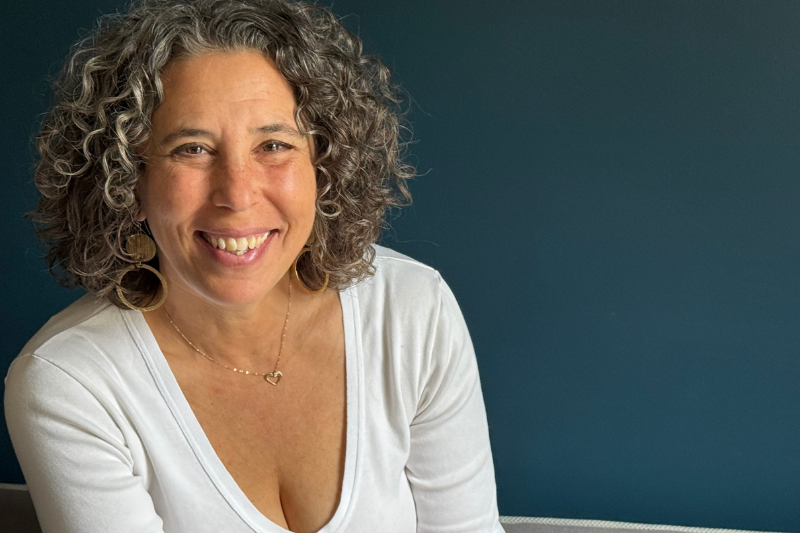
Rachel Yellin has supported thousands of births, run a private alternative therapy practice in San Francisco for 15 years, and taught online for more than a decade. She is the creator of Yes to Birth, a practice-based childbirth education program, and The Feel Good Life, a therapeutic coaching program for women who are done being “fine” and ready to feel fully alive.
She is also the kind of woman who walks into a saloon in Deadwood, South Dakota alone and leaves with adventure plans for the next day. More on that below.
Your bio says you've studied with world-class teachers and "tried just about everything, some of it a little wild." What's the wildest thing on that list you're actually willing to talk about?
There are a lot of things I've done for wellness and growth. I went to India for 51 days to do panchakarma, which is Ayurvedic treatment where they scrub you and stand on you and squeeze you and pour oil in your eyes and ears. Really intense.
But the story I'd rather tell is about trusting my intuition.
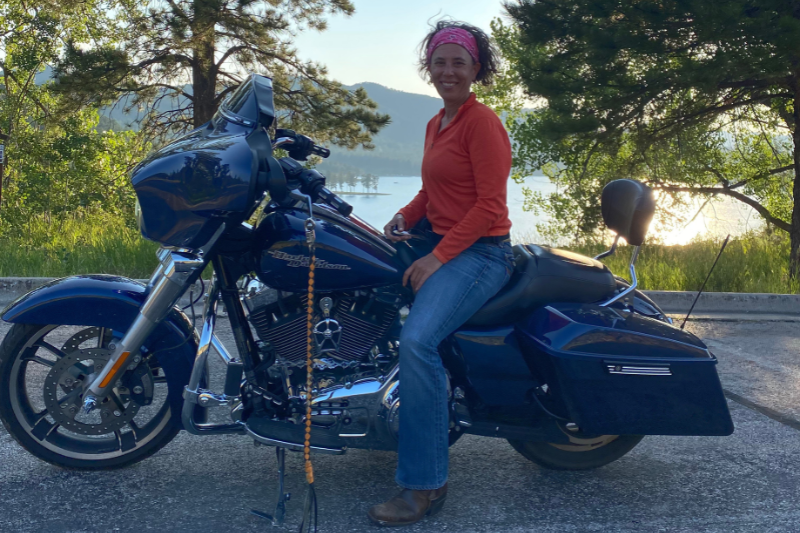
I love road trips by myself, and I love being a passenger on a motorcycle. So I drove from Denver to South Dakota to see Mount Rushmore, and I had this idea that I'd find someone to take me on a Harley ride through the Needles.
The woman at my hotel in Sturgis sent me up to Deadwood for live music. I put on jeans, an old t-shirt and sneakers and walked into “Saloon #11” full of locals, and the whole place went silent. Everyone turned, looked me up and down, and turned back. The only person who didn't look at me was a man with white hair, full-sleeve tattoos, a ring on every finger except his wedding finger, and a vest covered in patches.
When the band took a break, I said, "Excuse me, I was going to go to the Harley dealership tomorrow to try to hire someone to take me through Mount Rushmore. I see that you ride. Do you know anyone who might be available to take me?"
He gave me a sideways glance and said, "Nope."
About ten minutes later he turned to me and said, "I'll take you. I've got the day off."
I asked what he'd charge.
"Nothing."
The next day he was leaning against a massive lowrider Harley in an empty parking lot with a cigarette and a Mountain Dew. My only rule was no alcohol. He said, "I never drink on this bike."
I spent seven hours on the back of that bike. We sang Journey songs, he played AC/DC, and he took me to lunch at a place with wolves. He was a total gentleman.
My sisters were like, "You could be dead in a ditch."
But there wasn't one cell of me that doubted him.
That’s the fruition of the work I’ve done on myself. I didn’t have to talk myself out of fear. There just wasn’t any. I listened inward and knew I was okay.
It was one of the best days of my life.
“If a woman learned to truly be with herself, became comfortable with whatever she was experiencing mentally, physically, and emotionally, and then built that same relationship with her baby, she’d be able to go inside herself and give birth.”
You've supported thousands of births, run a private practice in San Francisco for 15 years, and built an online therapeutic coaching practice for over a decade. Two totally different worlds, birth work and nervous system healing. What's the thread that actually connects them for you?
Everything is about connection.
Connection to yourself, to the people around you, to something larger than yourself.
If people felt truly connected to themselves, we would live in a very, very different world. Most people are actively, and unconsciously, disconnecting from themselves all day long.
Birth and nervous system work look different from the outside, but my job in both is the same: I'm directing women back inside themselves.
The Feel Good Life is built for three types of women: the one who's "fine" but knows there's more, the high achiever running on empty, and the one who's done all the therapy and self-help and still feels stuck. Which one were you?
Honestly, all three.
I'd done a ton of work on myself and still felt stuck. I could make anything happen—I’m really good at that—and my life looked good, but I knew there was more.
And I'd had a private practice long enough to know that so many other women felt exactly the same way.
That's where The Feel Good Life came from. I created it for myself first. Once it existed, I went to my former birth students and said, "I'm doing this."
They said, "Whatever you're doing, sign me up."
That's the whole origin story. It wasn't a marketing plan. It was women I'd already been in the trenches with saying, "If it's you, I'm in."
You're very clear that The Feel Good Life is not a coaching program, even though people call it one. What is it, and why did you move it out of one-on-one work and into a group?
I don't even think of The Feel Good Life as a coaching program. It's much deeper than that.
It's a therapeutic, practice-based program that incorporates more than a dozen modalities and actually changes your nervous system. Not just how you think or what you're doing, but who you're being and how you are inside yourself.
I shifted into a group format because, after years of working one-on-one, I saw that one-on-one often keeps people talking about a different version of the same thing over and over.
Some women came to me saying, "Hold up a mirror. Tell me what I'm doing." Some came to vent and set the burden down. And honestly, I got tired and drained by people cycling their story again and again, or arguing for their own limitations.
What I discovered is that when I teach something, women can assess for themselves whether it applies to them.
So the group is not group therapy, and it's very important that people understand that. It's a stay-in-your-own-lane program.
Even though all the classes are taught live on line and we have a shared messaging app, women don’t talk to each other directly or make references to each other. They never give advice, overtly or covertly.
When I'm teaching a concept to 14 or 15 women, there's always someone who hears it and goes, "Oh my God, that's me."
And she doesn't feel picked on. She's claiming it.
Then the practices between classes start touching into what came up. Once she's claimed it, I can step in with proper therapeutic coaching—compassionate but very straightforward.
Not the "And how do you feel about that?" therapist line. Much more direct.
What's the point of all that self-reliance? Isn't the goal to have support?
The mission of The Feel Good Life is that every woman gets to be her own teacher, therapist, guide, partner, parent, and child.
She becomes a self-reliant ecosystem.
That doesn't mean she never needs anyone. Something tragic happens and of course she needs someone to cook for her and hold her hand.
But imagine if every time you had an upset, you knew how to handle it inside yourself.
Think about the time and energy most people spend seeking. They pay the therapist, then the psychic, then whoever's next.
Imagine instead saying, "I'm going to sit with myself for the next hour and work with my own anger, my own fear," and actually knowing what to do.
Then you go be with your kids with total ease, and the argument you had with a friend isn't bleeding into every other area of your life.
It's not independence that isolates you. It's the opposite.
I become so self-reliant, so self-loving, and so fierce and compassionate with myself that my bandwidth for everything else in life gets bigger.
That's what The Feel Good Life is really about.
The Feel Good Life has a module literally called "The Medicine of Self-Pleasure and the Pelvis." That's not a typical curriculum topic. Why does that belong in a healing program?
The Feel Good Life has its origins in a sexual trauma healing program, and I can easily say that the majority of women have experienced some kind of sexual trauma.
Big T trauma is the obvious. Little t trauma is the boyfriend who said, "Let me just put the tip in," or being catcalled by a group of men. And if a woman hasn't experienced it herself, she knows someone who has.
So here's why the pelvis.
This is not me making up woo-woo nonsense. If you looked at a cadaver, you'd see a plexus of nerves behind the heart, one behind the stomach—that's your literal gut feeling—and one in the pelvis.
The vagus nerve runs from the base of your skull through your whole body. If you pulled the whole nervous system out, it would look like a gorgeous tree.
There's no mind-body connection. It's one system.
We have a brain in our head, a brain in our heart, a brain in our stomach, and a brain in our pelvis. And every human being was designed to emerge through a woman's pelvis. It's a pretty powerful part of the body.
Use it or lose it.
If you don't engage the pelvis, the tissues start losing sensitivity. Most of us try to heal from the top down, brain into body. But if you attend to the pelvis, it proliferates back up into the brain.
If you took your hands right now and squeezed the flesh on your hips, your system would start generating oxytocin, and more oxytocin means more endorphins. That changes your chemistry, and your chemistry changes your thinking.
We have about 60 to 70 thousand thoughts a day, and 95 percent of them are the same thoughts we had yesterday. So people are trying to change their lives with yesterday's thoughts.
You have to interrupt the cycle.
Think about great sex. Your brain kind of stops. Then you do practices to change your thinking while your body feels good.
That's how you create new neural pathways.
Is The Feel Good Life for moms, or for all women?
All women.
My youngest student was 23 and my oldest was 72. Married, divorced, single, never married, straight, lesbian, with babies, with adult children, no children, wanting children, not wanting children.
Every configuration you can imagine.
It works for all of them.
Your team member titles are things like "Feel Good Goddess since 2020." That's not corporate coaching language. What's the story there?
Brianna worked for me first, and I told her that if she was going to keep working for me, she needed to do the program. So she was in the first group.
Kim, my lead coach, came in as a participant in the fifth cohort. She came in with a career pain point, feeling lost and stuck and not knowing what to do next.
Never did we anticipate she'd end up working with me and coaching in this way.
That happens a lot with The Feel Good Life. People come in because one thing is difficult for them, and then they realize that thing is just the presenting movie of their life at that moment.
There's something so much bigger longing to be addressed.
You've said your work is trauma-informed but never rehashes the past. Why does that distinction matter so much to you?
The Feel Good Life is not about digging around in your past for everything that went wrong.
We work the opposite way. We nourish you so much and build such a new paradigm that the new paradigm pushes up what's stuck.
Think about a garden. You start watering and fertilizing, and the first thing that happens is the weeds come up.
That's what The Feel Good Life is doing. It helps you feel so resourced on the front end that you have the capacity to deal with the harder things as they surface.
That's very different from regular therapy, where you walk in and start talking about what's painful, who did what, and how it's like your childhood. We don't do that.
On a very practical level, there's no platform in the program to go on and on about your history. In class, women share for two minutes. In the messaging app, three.
If something from the past surfaces, they work with it inside their practices and with Kim.
Here's how I explain it.
Say you won two goldfish at a fair, nobody cleaned the tank, the fish died, and you shoved the tank in the garage. Years later the kids want a goldfish.
You could get out a scrub brush and a Q-tip and wash every rock.
Or you could stick a hose in the bottom, turn on the clean water, and let the gunk spill over the edge.
It's kind of gross while it's happening, but you stay the course and keep the good water coming, and you flush out the crap without having to analyze the shit pile.
And I'll be transparent. It's not like you put the hose in and you're done forever.
Something came up recently in my own family that I hadn't realized was a shit pile, and I've been feeling anger and resentment in a way I never have before.
I'm the queen of the The Feel Good Goddesses and I'm sitting here resentful.
But I'm using my tools—not gracefully every minute—and I have the capacity to look at it now that I didn't have ten years ago.
That's what changes.
You get more centered, more grounded, more aware, and you can meet whatever arises while still being loving with yourself.
Let's talk about Yes to Birth. It's been going strong for over a decade with almost no marketing behind it. Why do you think it works?
Because it's non-dogmatic.
It holds steady to the physiology of birth. Yes, there's mindset work, but it's anchored in what the body is doing and how the body can facilitate the best birth experience.
Ninety-eight percent of mammals in the wild have totally normal, healthy births with nobody shouting, "Push, push, push."
And we're mammals.
It's also a practice-based class. You learn the information, understand why you're doing what you're doing, and then you go practice.
Not breathing a couple of times. Really practicing. Going inside. Reprogramming your mindset.
Our brains do everything possible to stay with what's familiar. If your paradigm is that birth is scary and that the sensations of birth (aka pain) are bad, you'll walk in asking, "Is everything okay? Can you check the baby?" and they'll find something.
But if you learn something new based on the science of the body and practice it, there's a much greater chance the new template takes over when birth begins.
It feels familiar.
It feels like something you're excited to do.
Yes to Birth is not centered around having a natural birth. It's centered around a positive experience for the mother and the baby and whoever she chooses to have with her.
Most of my students have hospital births. If I have 15 couples in a class and two are planning home births, maybe one to four of the others switch, and the rest walk into the hospital ten times more confident, knowing how to have a beautiful, meaningful experience there.
Nobody comes away feeling like Rachel told them how to do it.
It's: How do we build the skills and the vision and create the best conditions, knowing the baby has their own destiny and we don't get to control it?
That's a really hard dichotomy, and I think I hold it incredibly well.
You've never had children yourself. Has that ever come up with the families you work with?
People have consistently told me it's pretty amazing that I can teach what I teach and support the way I support without having had kids.
I actually think it's been an asset.
I never compared anyone's experience to my own, and I never projected my experience onto anyone else.
A lot of birth professionals do that. They only know the hospital, or only home birth, or only their own story.
I've seen such a variety that when someone asked me a question, I never said, "Let me tell you how it is."
I said, "Sometimes it's like this, sometimes it's like that."
We don't ultimately know. We do the best we can with the information we have, and we listen inward.
What's the biggest misconception moms have going into birth that Yes to Birth was built to correct?
That birth is a problem waiting to be fixed.
It's not.
The other big one is that they need help.
So many women are trained to look outside themselves for the answers.
"I trust my doctor. I trust my midwife. I trust my doula."
As a doula, when someone said, "Whatever you tell me to do," I'd say, "Oh no."
My job is to direct people inside themselves.
If a woman learned to truly be with herself, became comfortable with whatever she was experiencing mentally, physically, and emotionally, and then built that same relationship with her baby, she'd be able to go inside herself and give birth.
I've sat outside a door for hours at incredible births, just refilling the water jug, letting her be.
I call it being self-referred.
I check with myself first.
What do I need? What do I think? How do I feel?
Then I turn to someone else.
After 23 years of doing this, I still have to remind myself when I'm dysregulated: Wait. Go inside first. Don't pick up the phone. Don't AI it.
And to be clear, I recommend doulas no matter what. Even if a woman wants the most solitary, mammalian birth possible, I say get the doula for your partner, so somebody's there when you start pushing in the bathroom.
If someone's reading this and wondering whether one of your programs is for her, how does she know?
If you're thinking about having a baby, or you're pregnant, come to Yes to Birth.
If you're crying in your car on a regular basis, if you're anxious all the time, if you love your kids but can't stand your kids, if you're unhappy in your marriage, if you're overwhelmed and not sleeping well, come to Feel Good Life.
And if you just want a taste of how I work, there are free programs on my site.
Start there.
Explore Yes to Birth
Learn about Feel Good Life
Try Rachel's free programs and masterclasses
Connect with Rachel Yellin on Facebook or Instagram.
You can also find Rachel on The M List, The Mamahood's searchable database of mom-recommended resources, or connect and collaborate with her inside The Club membership for women Founders.